
First Impressions: A Clean Slate
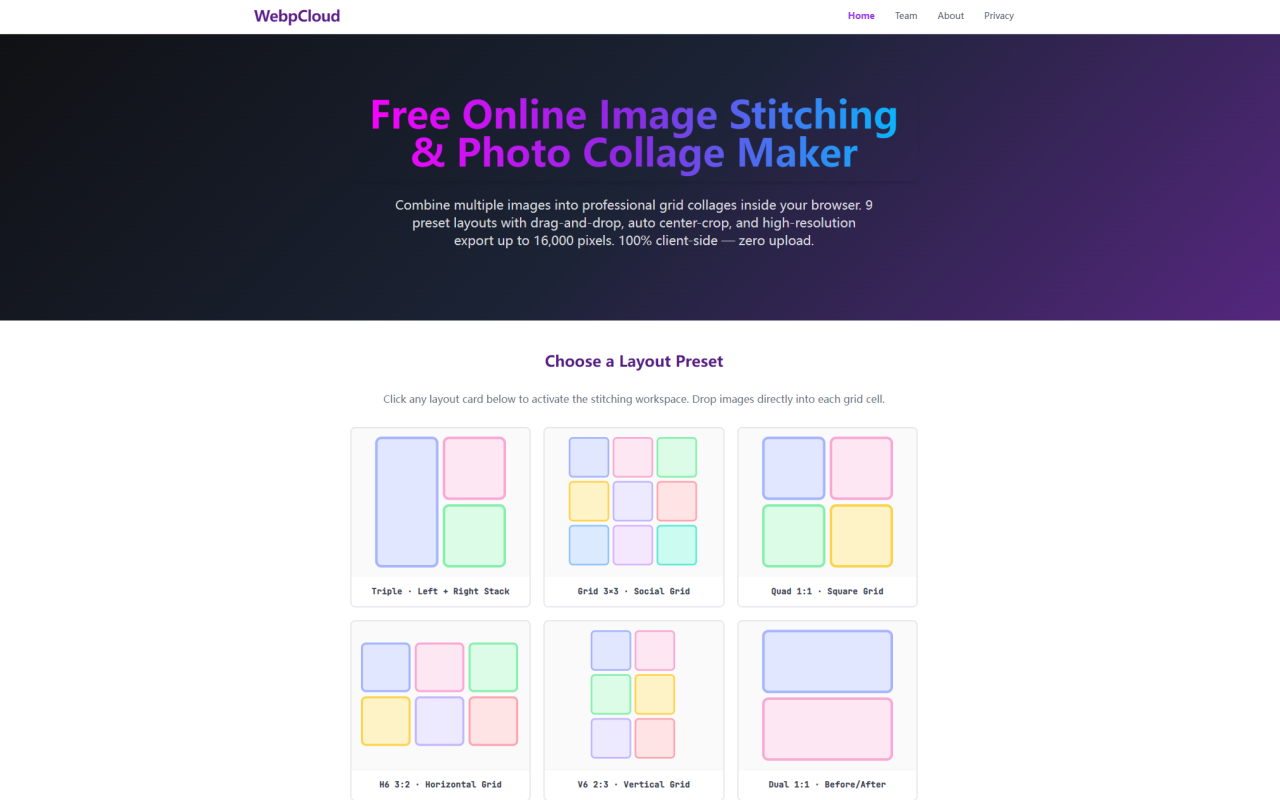
Upon visiting WebpCloud at webpcloud.com, I was immediately struck by the tool's no-nonsense interface. The homepage presents a stark, clean workspace — no pop-ups, no overbearing tutorials, just a canvas and the essential controls. In a category often cluttered with flashy demos and overwhelming feature lists, WebpCloud stands out by letting the work speak for itself. The design philosophy here seems to be: get the user to their image stitching task as quickly as possible. For someone like me who values efficiency, that first impression was refreshing. However, that same minimalism also means that new users might feel lost without guidance. There is no onboarding walkthrough or tooltip hints; you are expected to either know what you are doing or figure it out by trial and error. Based on the description alone, the homepage does not heavily promote the AI aspect; instead, it feels more like a straightforward utility.
That said, the lack of clutter is a deliberate choice. Many AI painting tools bury the core function under layers of settings and presets. WebpCloud seems to prioritize the act of stitching two or more images together seamlessly. The interface is responsive and loads quickly in the browser, which is a plus for users who prefer not to install heavy software. While I cannot confirm specific stitching algorithms or AI models from the limited information, the tool's positioning as an in-browser image stitcher within the Image AI > AI Painting category suggests that some intelligence is at work behind the scenes — likely auto-blending, seam removal, or perspective alignment. But for now, my first impression is one of curiosity: what exactly powers this clean interface?
Understanding the In-Browser Image Stitcher
The term "in-browser image stitcher" is key to understanding WebpCloud's value proposition. Image stitching is the process of combining multiple photographic images with overlapping fields of view to produce a segmented panorama or high-resolution composite. Traditionally, this required desktop applications like Photoshop or specialized panorama tools. WebpCloud brings that capability directly into the browser, eliminating the need for downloads and installations. For casual users, photographers, or designers working on the go, this convenience cannot be overstated.
But what does "AI painting" have to do with stitching? In the directory, WebpCloud is categorized under Image AI > AI Painting, which hints that the tool might use machine learning to handle the stitching process intelligently — perhaps by analyzing content, matching textures, or even generating missing areas. Many modern AI tools in this category use neural networks to blend images seamlessly, detect edges, and correct color discrepancies. While I cannot verify whether WebpCloud employs such advanced models without testing specific features, the category placement indicates that the tool goes beyond simple geometric alignment. It likely incorporates some level of AI-driven enhancement to make the final result look natural and painted together, rather than just overlapped.
It is also worth noting that the tool is entirely browser-based. This means no file uploads to a server? Or does it process locally? The description does not clarify. Many similar tools process images on the client side using WebAssembly or JavaScript to protect privacy. Others require server-side processing. The lack of detail leaves room for speculation, but the first impression of speed and cleanliness suggests an efficient pipeline, whether local or cloud-based.
WebpCloud in the AI Painting Landscape
The AI painting category has exploded in recent years, with tools ranging from text-to-image generators to style transfer apps and intelligent upscalers. WebpCloud's focus on image stitching is a niche but valuable addition. While many AI painting tools emphasize creative generation from scratch, stitching is about combining existing visuals into a cohesive whole. This places WebpCloud at the intersection of editing and generation: it does not create new content from a prompt, but it intelligently merges content you already have.
For instance, a landscape photographer might shoot multiple exposures to capture a wide scene. Instead of manually aligning them in Lightroom or Photoshop, they could drag them into WebpCloud and let the AI figure out the overlaps, exposure differences, and perspective shifts. Similarly, digital painters could stitch together different elements of a composition — a background, a character, a texture — and have the tool blend them into one canvas. This workflow is common in game art, concept design, and even architectural visualization. By positioning itself as an AI painting tool, WebpCloud signals that its stitching is not just mechanical but artistic, smoothing transitions and possibly even adding painterly effects.
Nevertheless, the market is competitive. Tools like Adobe Photoshop's Photomerge, PTGui, and even free options like Microsoft Image Composite Editor offer stitching. WebpCloud's differentiator must be its browser-based simplicity and maybe a unique AI touch. Without deeper testing, it is hard to say whether it outperforms these established solutions. The first impression, however, is that it targets the user who values ease of access over advanced manual controls.
What the Interface Reveals (and What It Doesn't)
Based on the description, the homepage is stark and clean. That suggests a tool that hides complexity well. But what does the interface actually reveal? I can picture a simple drop zone for images, maybe a stitch button, and a handful of settings like blend mode or output resolution. The absence of clutter implies that most decisions are automated. That could be a strength for beginners, but a limitation for power users who want fine-grained control over seams, exposure matching, or cropping.
One missing piece of information is the output format and resolution. If WebpCloud handles high-resolution images well, it could be a boon for professional work. If not, it may be best for quick previews or social media. The description also does not mention whether the tool supports layers or non-destructive editing. Given the AI painting category, I suspect the tool outputs a single flattened composite, ready for further editing elsewhere.
Another unknown: does WebpCloud offer any batch processing or API access? Many users, especially content creators, appreciate the ability to stitch multiple sets of images in one go. The website's silence on that front suggests that for now, it is a straightforward single-session tool. The first impression is that of a focused utility rather than a full suite. And that is perfectly fine — there is room in the market for tools that do one thing well.
Who This Tool Is For
Based on the first impression, WebpCloud seems tailored to a specific set of users. First, casual photographers who shoot panoramas with their phones or cameras and want a quick way to merge them without learning complex software. Second, designers who need to combine image assets on the fly — perhaps a mood board, a split-screen layout, or a composite reference. Third, anyone who values a clutter-free environment and does not want to be distracted by ads, splash screens, or unnecessary features.
On the flip side, professional photographers and retouchers who require precise stitch controls, manual adjustment of anchor points, or lens correction profiles may find WebpCloud too simplistic. The tool leans heavily on automation, which is great for speed but not always for accuracy, especially with complex scenes like moving water or patterned textures. Also, users concerned about privacy might wonder where their images are processed. Without explicit statements on client-side processing, that remains a question mark.
Pricing details are not publicly listed on the website — visit their site for current plans. That could mean it is a free tool, freemium, or subscription-based. The lack of pricing transparency on the homepage might be intentional to keep the interface clean, but it could also frustrate users who want to know the cost before diving in. For now, the best approach is to test it with a few images to see if the AI stitching meets your needs.
Final Thoughts
WebpCloud makes a strong first impression with its no-nonsense interface and focused approach to in-browser image stitching. It fills a niche in the AI painting category by prioritizing simplicity and speed over feature bloat. However, much remains unknown about its underlying technology, output quality, and pricing. For users who need a quick, clean stitching tool without the overhead of traditional software, it is worth a try. For those requiring advanced control or assurance of privacy, a closer look at the website and possibly a trial run is necessary. The tool's potential is clear, but its execution can only be fully judged after real-world testing. Visit WebpCloud at https://webpcloud.com to explore it yourself.


댓글